biography
Mangesh Gajjar, once half of the celebrated composing partnership Nitin‑Mangesh, is a uniquely inventive Indian film‑music composer with more than a decade of experience in Mumbai’s vibrant cinema scene. Over his career he has crafted memorable scores and songs alongside some of Bollywood’s most iconic playback legends - Mohammed Rafi, Kishore Kumar, Lata Mangeshkar, Manna Dey, and Asha Bhosle.

One of many Filmfare magazines Mangesh would avidly collect and read.
From the moment he could remember, Mangesh has been drawn to the world of sound. As a child he spent endless afternoons immersed in the recordings of legendary film composers and playback singers, letting each melody shape his imagination. The timeless voices of Lata Mangeshkar and Kishore Kumar struck a chord deep within him, prompting a self‑taught foray into singing and playing the harmonium during his early teens.
Among the myriad influences that guided his path, the partnership of Shankar‑Jaikishan stands out as the most pivotal. Their three‑decade reign over mainstream Hindi‑cinema music defined an era, and their work became the blueprint for Mangesh’s own aspirations in film scoring. Equally formative was Mangesh’s admiration for the iconic actor‑director Raj Kapoor. He was fascinated not merely by Kapoor’s performances but by his holistic grasp of cinema - how song, choreography, and editing intertwined, and how a well‑timed pause or a subtle gesture could let music carry the full weight of emotion. Witnessing this synergy planted a seed in Mangesh’s mind: one day his own compositions could also bring to life and animate characters on screen, just as Shankar-Jaikishan’s songs did.
Inspiration
Mangesh’s personal canon includes many Shankar‑Jaikishan masterpieces that feature Kapoor - “Ghar Aaya Mera Pardesi” (Awaara, 1951), “Pyar Hua Ikrar Hua” (Shree 420, 1955), “Jeena Yahan, Marna Yahan” (Mera Naam Joker, 1970), and many others. These pieces embodied the qualities he strived to emulate: instantly catchy, hummable melodies wrapped in sweeping, cinematic orchestration that ebbs and flows with the narrative. The inventive rhythms, layered vocal textures, and the seamless marriage of Western harmonic concepts with classic Indian melodic motifs wove a vivid emotive tapestry that left him mesmerized, and that he sought to capture this in his own future scores.
Shankar‑Jaikishan’s music opened a gateway for Mangesh to explore the subtleties of songcraft and deepened his yearning to join the creative fold. He became an avid collector of articles, newspaper profiles, and countless Filmfare features on the legendary duo. Their shared roots in Gujarat forged a personal bond, resonating with Mangesh’s own affection for traditional Gujarati folk melodies. Many of Shankar‑Jaikishan’s scores were paired with the lyrics of Shailendra - a poet whose deft blend of plain‑spoken diction, everyday imagery, and profound emotional and philosophical currents captivated Mangesh. He admired Shailendra’s warm, conversational tone, studying it closely to inform his own lyrical sensibility.
Mangesh penned his first composition as a teenager, earning enthusiastic encouragement from friends and family. He then enrolled at a classical music academy in Rajkot, where he spent two years deepening his technique and mastering the fundamentals of Indian music. There, he immersed himself in the study of ragas - melodic frameworks that evoke distinct emotions - which help built an "emotional palette" that would later help color his diverse body of work.
During the 1960s, Mangesh founded the ten‑member ensemble Young Artists Circle, a troupe of versatile musicians who championed the works of Shankar‑Jaikishan, performing many of their songs. Their energetic tours across Gujarat earned them a loyal following and established the group as a fresh voice on the state’s music scene. Through a mutual acquaintance, he met Nitin, a fellow enthusiast of both Indian and Western traditions who hailed from Sudan. Their camaraderie blossomed into a creative partnership, culminating in the formation of BlueBird. With BlueBird, they debuted original material that spanned heartfelt ballads to high‑octane qawwalis - styles rarely combined by any other act at the time. Their innovative repertoire and dynamic performances quickly captured audiences, cementing their reputation as trailblazers throughout Gujarat. With the backing of their growing fan base, Mangesh and Nitin felt bold enough to bring their songs to Mumbai, the epicenter of Hindi‑film music.

Nitin and Mangesh (Left) rehearse for one of their stage shows alongside their fellow musicians.
Formation of duo Nitin-Mangesh
First release
After years of grind, setbacks, and a handful of unreleased projects, they finally broke through with Samaanta in 1972. The film’s soundtrack boasted playback legends Mohammed Rafi and Manna Dey, lyrics by Qamar Jalalabadi, and arrangements by Sebastian D’Souza, a veteran orchestrator famed for his work with Shankar‑Jaikishan.
Nitin also stepped in front of the camera, taking a small acting part at the invitation of director Nitin Bose. The background score was entrusted to Mangesh, who described his compositional method as “intuitive and organic” -melodies that emerged almost spontaneously, sparked by a single word or premise. This instinctive approach shines in the track “Is Duniya Mein Rahne Wale,” which he crafted swiftly, yet precisely, to meet the director’s brief for a song echoing the vigor of “Dur Hato Ae Duniya Walo” from Kismet (1943).

During the sessions for “Sathio Sun Lo Zara 2,” Rafi confessed a lingering nervousness about the track, particularly the soaring high notes. “Mangesh Ji, yeh gaana jis ka main rehearsal kar raha hoon, wo Duniya Ke Rakhwale jaise uncha gaane to nahin hai?” “Mangesh Ji.." he asked, “the song I’m rehearsing, does it involve very high notes like 'Duniya Ke Rakhwale’? He recalled the 1952 Baiju Bawra hit “O Duniya Ke Rakhwale” which had taken a toll on his voice; pushing into the fourth octave, leaving his vocal cords strained for many days. Mangesh’s steady encouragement eased Rafi’s doubts, and the singer rose to the occasion, delivering a performance as brilliant as ever. Later the dynamic shifted. Sensing Mangesh’s concern about the film’s modest budget, Rafi offered reassurance:
“Mangesh Ji, main to mafat mein gaaya hai, daar na nahin! Chalo, hum rehersal kar le...”
“Mangesh Ji, I have sung for free on many occasions, have no fear. Let’s just rehearse and make it happen...”
Manna Dey, (Left) Sebastian D'Souza, Nitin. Mangesh (right) guides the music direction for "Is Duniya Mein Rahne wale" from Samaanta (1972).

Mohammed Rafi (left) rehearsing "Sathio Sun Lo Zara" from Saamanta (1972) as Mangesh (right) directs the song on harmonium.
Despite its artistic success, Samaanta later faced a government ban because of its overt political themes, underscoring the daring spirit that defined the duo’s early forays into the Hindi film industry.
Left to right: Nitin, Kishore Kumar, Mangesh and Maya Govind after completing the recording for "Yeh To Zindagi Hai" from Qaid (1975).
For “Yeh To Zindagi Hai”, Nitin’s distinctive Arabic‑style vocalisation shines through midway through the number. Kishore Ji was so struck by the technique that he expressed a genuine desire to learn it from Nitin, and the entire studio crew was visibly impressed. For “Beliya Alle Beliya” , Nitin contributes spoken Arabic phrases that recur throughout the track, complimenting Asha Bhosle’s melodic line. Throughout the track “Diwana Hoon Pyar Ka” , he repeatedly exclaims the word “Deewana.” Concerned about straining his own vocal cords, Kishore Kumar invited Nitin to deliver those powerful exclamations, and he obliged with gusto. These collaborations played a pivitol part in also cementing Nitin’s reputation as a versatile vocalist, as well as co-composer and song writer.
Breakthrough
Their breakthrough arrived in the mid‑1970s when they secured a deal with Guru‑Dutt Films for the title Qaid (1975). The playback roster boasted legends Kishore Kumar, Asha Bhosle and Lata Mangeshkar, and the film went on to enjoy a remarkable run of more than 20 weeks in Indian theatres, earning the prestigious Silver Jubilee distinction. Nitin contributed guest vocals to three of the soundtrack’s songs.

Fresh off the triumph of his previous venture, Mangesh felt an irresistible pull back to India. He wanted to capture the rustic melodies of his native land and ground his music in the cultural heartbeat of his childhood. In 1978 he teamed up once again with his long‑time collaborator Nitin to compose the Gujarati feature Parnetar, which Mangesh also co‑produced. The film was shot amid the rural areas of fields and lanes of Bagasara, Gujarat, giving the project an authentic village backdrop.
The soundtrack's lineup included Manna Dey, Usha Mangeshkar, and Bharati Vyas who lent their voices, while lyricist Kanak Thakar wove the words. Mangesh also stepped behind the microphone for a duet with Usha Mangeshkar titled “Tare Ne Mare,” a love song that rides on a simple folk motif. Among the songs, “Maru To Gamdaru” quickly became Usha’s personal favorite; she lingered over its final mix, drawn to its melodic charm.
Parnetar marks the moment Mangesh fully immersed himself in the traditional Gujarati soundscape - bhajans, garba beats, and lyrical ballads, all rendered with a bright, celebratory energy yet rooted in the earthy tones of folk music. The arrangements, shaped by Shalilesh Pujaria (who also scored “Teri Yaad Aayee”), conjure an intimate tableau that places the listener right in the middle of a lively village gathering. The film was not released due to issues with the financer and final contract.
The Gujarati flavour lingered long after the movie wrapped, threading its way into Mangesh’s subsequent solo material. It shines brightest in the sentimental and poignant song “Dur Dur Hum Jayenge,” where the familiar, earthy warmth and folk-tinged melodic contours once again evoke his hometown’s musical heritage.
A Musical Journey & Reconnecting with Roots
Driven by a deep love for Indian folk music, Mangesh set out in the mid‑1970s to realize an ambitious vision that would bridge Eastern tradition with Western ears. He made the bold, solitary decision to travel to the United Kingdom, where he could pursue his vision of introducing traditional Indian melodies in a form that resonated with British audiences. He aimed to present the richness of Indian folk in a way that felt natural and appealing. By weaving together Indian tonalities and Western musical nuances, he sought to craft something fresh and compelling. As he explained in interviews on the BBC’s weekly Asian‑news program Gharbar and on BBC Radio, his goal was to make the music both authentic and accessible.
In 1975 Mangesh released “Teri Yaad Aayee,” a ten‑track album he both composed and musically directed. The record blends memorable vocal melodies with lyrical sentimentality, evoking a nostalgic, rural‑folk atmosphere. Notably, two songs feature a full male English choir, adding a distinctive cross‑cultural texture that underscores Mangesh’s pioneering fusion of East and West.

Mangesh directs the music for "Teri Yaad Aayee" in a London studio (1975)
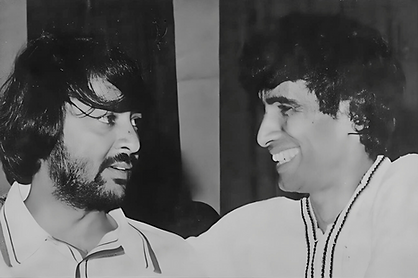
Nitin and Mangesh remained close friends for many years.
New horizons
Nitin and Mangesh’s last joint venture appeared in the 1980 Guru Dutt Films release Khanjar, helmed by director Atma Ram. The score was brought to life by playback singers Jaspal Singh, Aarti Mukhherjee, Usha Timothy, Aziz Nozan, Anjali and Mehmood. The film’s soundtrack is remembered especially for the haunting “Zinda Hon Magar Zinda Hoon Nahin” and the romantic anthem “Tum Meri Zindagi Ho.”
Nitin and Mangesh eventually went their separate ways, parting on amicable terms to pursue fresh personal and artistic directions. Mangesh settled in the United Kingdom, where he focused on raising a family and revived his passion for live performance. He assembled a collective of UK‑Asian musicians, touring extensively across the country. With a repertoire of timeless Bollywood classics that sparked nostalgia for the British-Indian community, they quickly became a beloved fixture/crowd‑pleaser at local community events. Meanwhile, Nitin stepped back from music to explore a range of other interests, dedicating his energy to pursuits outside the recording studio.
Even after their amicable split, Nitin and Mangesh remained close friends, exchanging letters and occasional phone calls that kept their shared memories alive. Their friendship endured until Nitin’s untimely passing in 2012 due to ill health.
Whilst residing in the UK, he has composed English songs and collaborated with several UK artists, including Leesha Paradise for her single “Waiting” and Jona Lewie, contributing to Lewie’s early-1980s single "Love Detonator".
Mangesh continued to compose, write, and record a wide range of Hindi songs intended for Hindi films, gradually building a substantial collection of original work. Many of these pieces were later featured in his most recent collaboration with UK artists for the 2024 album Namaste Bombay.
His work flowed from a desire to weave stories, stir the heart, summon nostalgia, and open doors to realms only music can create.
Philosophy
His approach to composing was rooted in the belief that a song should be born as a complete whole. Melody and lyrics were inseparable to him - they arrived together, intertwined from the very first moment. Over the years, he refined this organic, instinctive method into his signature style. As he described it,
" I hear the melody, it is already within each syllable. It is not about placing words into a melody to make them fit…
it is about tuning into the frequency of the words and letting the melody grow around them, creating a single, living entity.”
For him, this was the true beginning, the birth of a film song.